
Description
Professional Avionics Sensor & Long-Range Telemetry Ecosystem: High-Precision GNSS/RTK, Redundant Industrial Sensing, and Data Links by CUAV, Holybro, and Matek
This industrial-grade avionic sensor and telemetry ecosystem integrates a curated selection of advanced hardware components from industry leaders CUAV, Holybro, and Matek Systems. Engineered to provide a robust physical and data layer for tactical Unmanned Aerial Vehicles (UAVs), high-endurance fixed-wing aircraft, and hybrid VTOL platforms, this unified sensor suite delivers centimeter-level positioning accuracy, multi-layered data redundancy, and highly resilient long-range communication links. Designed to interface natively with standard Pixhawk, Cube, and Matek hardware running open-source PX4 or ArduPilot flight stacks, this ecosystem forms the vital sensory backbone required for fully autonomous enterprise inspections, high-fidelity mapping, and persistent surveillance missions.
1. High-Precision GNSS / Real-Time Kinematic (RTK) Positioning Nodes
Standard GPS modules often experience positional drift, which can compromise precision automated operations. This ecosystem upgrades positioning capabilities with sub-meter and centimeter-level tracking arrays:
-
Centimeter-Level Real-Time Kinematic Arrays (CUAV C-RTK 9Ps / Holybro H-RTK F9P): Built upon the elite u-blox ZED-F9P multi-band GNSS platform, these systems simultaneously track four major satellite constellations (GPS, GLONASS, Galileo, and BeiDou). Achieving real-time convergence in under 60 seconds, they deliver an absolute horizontal positioning accuracy of $1text{cm} + 1text{ppm}$ CEP, eliminating positional drift entirely.
-
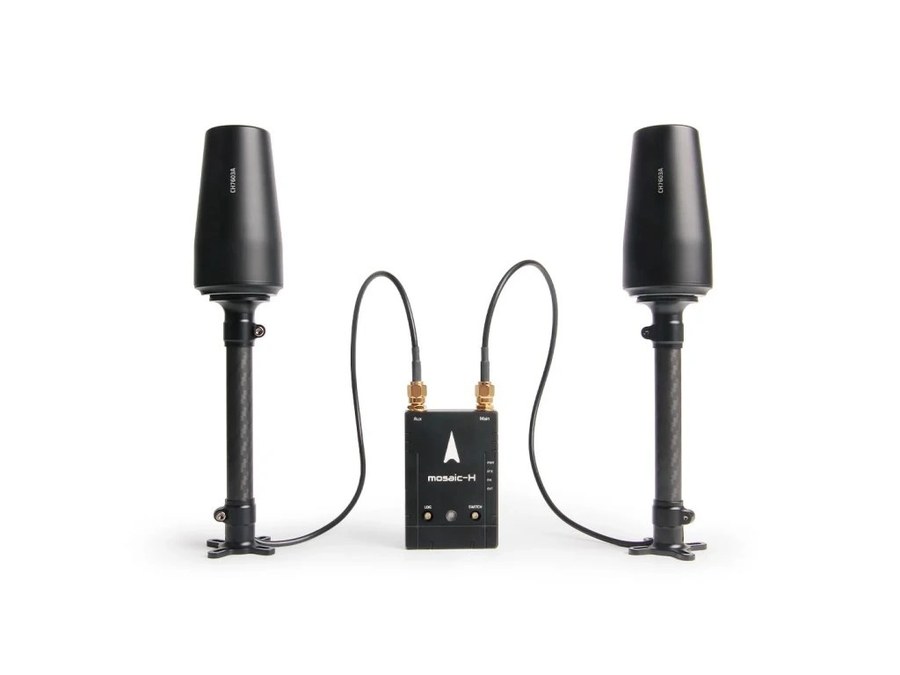
Dual-GNSS Moving Baseline Heading (Compass-Free Yaw): By deploying twin RTK units (a dual-rover or rover/base configuration) on a single airframe, the autopilot can compute Dual RTK for Yaw. This system calculates an incredibly precise heading reference ($0.4^circ$ accuracy) entirely independently of the earth’s magnetic field, allowing drones to fly safely in high-EMI environments like high-voltage power grids or industrial steel refineries that normally blind traditional compasses.
-
Next-Gen Industrial GNSS Units (CUAV NEO 3 Pro): Utilizing the high-performance u-blox M9N engine, these standard units feature a built-in RM3100 or IST8310 external magnetometer, active bandpass filtering, and advanced anti-spoofing/anti-jamming algorithms to secure normal navigation links against localized signal contamination.
2. Multi-Layered Redundant Sensing: Industrial IMUs and High-Fidelity Altimeters
To safeguard critical flights against internal component failures, the ecosystem introduces independent sensor nodes that continuously cross-reference flight metrics:
-
External Redundant IMU & Compass Nodes: Compact auxiliary boards house high-performance trójosiowe (three-axis) gyroscopes and accelerometers. Operating as secondary or tertiary fallback units, these external IMUs communicate via high-speed, noise-tolerant DroneCAN (UAVCAN) or SPI buses. If a main flight controller’s internal IMU experiences a sudden thermal shift or vibration clipping, the autopilot seamlessly falls back to the external sensor without losing control.
-
Precision Barometric Altimeters (Matek CAN/I2C Barometers): High-resolution atmospheric pressure sensors provide localized altitude referencing. These modules process subtlest pressure shifts to output precise relative altitude metrics, ensuring highly stable altitude-hold performance down to the centimeter level during automated terrain-following routines.
3. Advanced Airspeed Variants for Dynamic Flight Stabilization
For fixed-wing and hybrid VTOL platforms, relying purely on GPS ground speed can lead to disastrous aerodynamic stalls during sudden tailwinds or headwind shears. This suite features specialized differential pressure sensors:
-
Matek ASPD-4525 Digital Airspeed Sensor: A lightweight ($3.5text{g}$) I2C digital sensor core running the trusted TE 4525DO pressure sensor matrix. It features a $pm0.25%$ SPAN accuracy ceiling, delivering crisp airspeed readouts directly to ArduPilot and INAV setups via a clean JST-GH digital interface.
-
Matek ASPD-AUAV DroneCAN Sensor: A high-speed, heavy-duty airspeed variant utilizing an integrated STM32L431 CAN micro-node. It handles a massive speed monitoring threshold of up to 400 km/h ($111text{ m/s}$) with virtually zero zero-point pressure offset in still air, streaming packets over the ultra-reliable DroneCAN protocol.
-
CUAV SKYE 2 Heated Auto-Icing Pitot System: Designed for all-weather tactical deployments, this premium DroneCAN airspeed sensor features an integrated intelligent heating element. It automatically detects freezing temperatures and melts away moisture and ice buildup, preventing pitot-tube clogging during high-altitude cloud penetrations or winter operations.
4. Ruggedized Telemetry Radios for Secure Long-Range Data Links
To maintain an unjammable command, control, and telemetry stream between the host aircraft and the Ground Control Station (GCS), the ecosystem deploys long-range industrial data links:
-
Holybro SiK Telemetry Radio V3 / Long-Range 1W System: Operating across regional Sub-GHz bands (433MHz / 915MHz), this transparent full-duplex serial link natively wraps and optimizes MAVLink protocol data framing. The flagship 1W (30 dBm) Long-Range variant features Frequency Hopping Spread Spectrum (FHSS) technology across 50 independent channels and includes built-in error correction algorithms capable of recovering up to 25% of corrupted data bits. It establishes a rock-solid, real-time command link stretching several kilometers with standard omni antennas, and past 20+ kilometers when paired with a ground directional patch antenna.
-
ExpressLRS High-Speed Telemetry Radios: Utilizing the highly efficient LoRa modulation architecture, these data links provide a ultra-low latency alternative for real-time mission tracking, parameter adjustment, and continuous flight path synchronization through standard Mission Planner or QGroundControl platforms.


Reviews
There are no reviews yet.